
Listening to those who experience the system is the first step to changing it

Listening to those who experience the system is the first step to changing it: refugees and asylum seekers talk about their relationship with banks and financial services
Roma, “It’s hard to understand and to make yourself understood”, “It often seems that staff don’t trust us”, “An app in several languages would be very useful”.
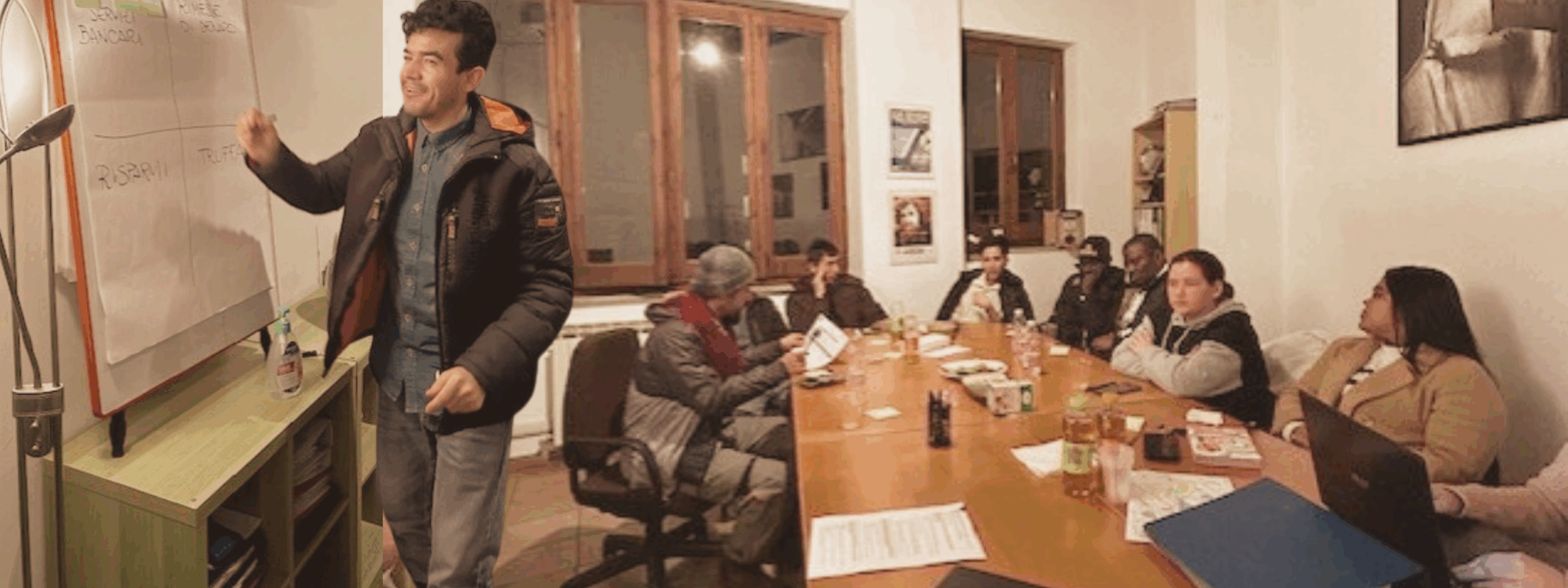
These are some of the voices that emerged during the focus group organised by the Italian Council for Refugees (CIR) as part of the PAF! project – Financial Literacy Programme. This methodology has proved particularly useful in giving a voice to the people the project’s actions are aimed at, and in actively involving them. One of these focus groups was also held in Roma: eight people, holders of international protection and asylum seekers, shared concrete experiences of accessing banking and postal services in Italy, an access that is often obstructed.
Even though all participants have an account, language barriers, misinformation and above all mistrust persist, along with, unfortunately, occasional discriminatory treatment by counter staff. In some cases, the impossibility of communicating led to frustration and to people giving up. In others, access to an account was denied despite regular documentation, due to arbitrary interpretations of the requirements.
It is important to build a more inclusive financial system, with multilingual counters, simplified apps and staff trained not only in procedures, but also in welcoming people and showing respect. The direct experience of refugees is a fundamental resource for identifying effective solutions: listening to it is a duty, valuing it is a necessity. Only in this way can financial inclusion become a concrete reality instead of remaining an abstract principle.
This is what the PAF! project sets out to do. Once the research phase is over, tailored information tools will be developed, useful both for the foreign population and for workers in reception centres and migrant help desks. Training sessions will be organised to give the project’s target groups the essential notions of financial education they need to move easily and safely in the financial sphere. In the final phase of the project, a service design action will be launched with all the financial ecosystems of the regions involved.